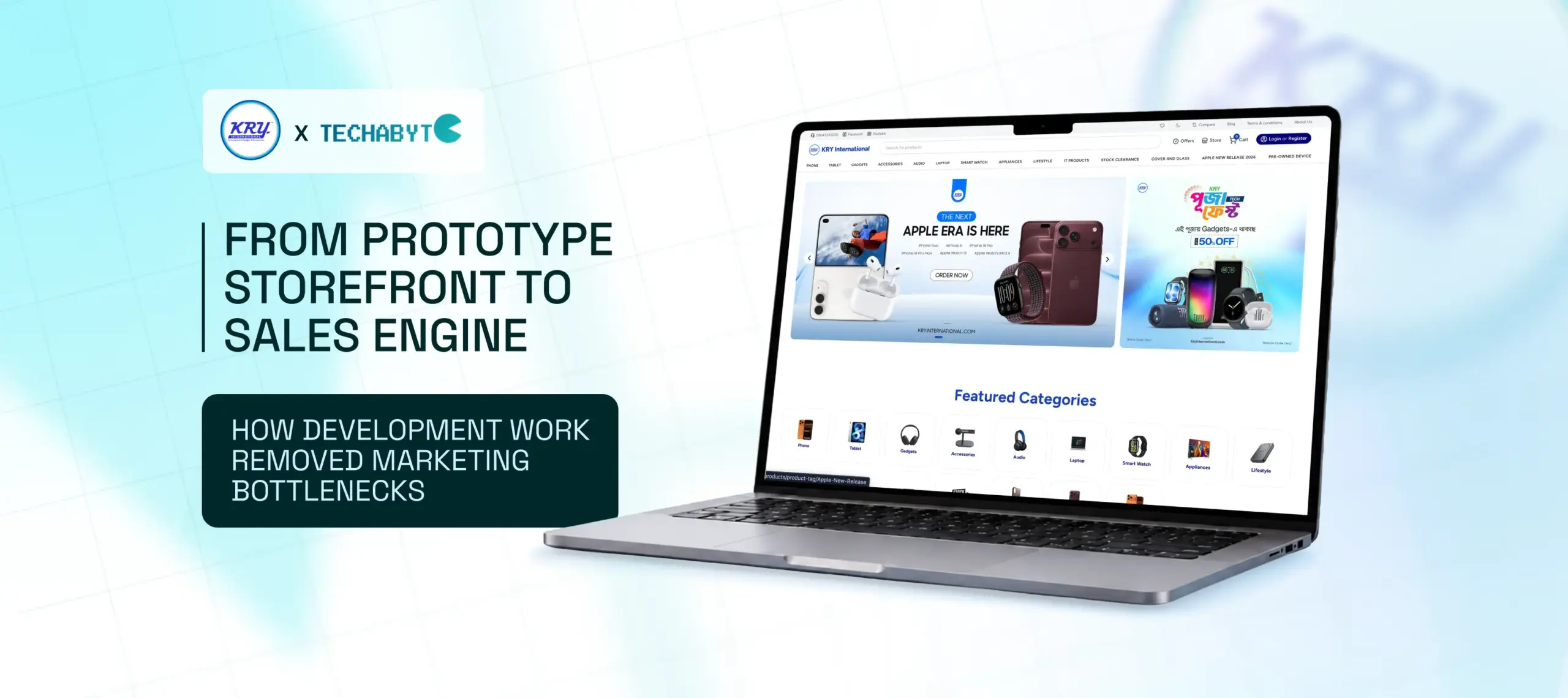
Client Overview
| Client | KRY International |
| Industry | Electronics retail, Bangladesh (online store and physical branches) |
| Timeline | March to September 2026 |
| Services | Storefront, Admin Portal, API, SEO, Omnichannel Automation, Analytics |
| Delivered by | TechaByte Solutions |
At a glance:
| 475 commits | 183 defects fixed | 5 work stages | 3 applications | 64 daily engineering logs |
Executive Summary
KRY International, a Bangladeshi electronics retailer, set out to become the country’s most trusted “Everything Store.” What it had was a prototype storefront: a sitemap leaking debug lines, discounts that overwrote real prices, a registration wall before checkout, and no way to run a campaign without a developer.
TechaByte Solutions treated each of these as a marketing bottleneck, not a coding ticket. Between March and September 2026, we fixed 183 issues, rebuilt the sitemap and search so the catalogue can be found on Google, hardened the production stack, made pricing trustworthy, and then built the conversion and automation tools that sell.
What the work delivered: In the three months to 27 September, the store recorded 155,000 Google clicks at a 9.1% average click-through rate and an average position of 8. Admin price and stock changes now reach the live site in about 2 seconds. To date, one in five orders has used loyalty points. And KRY’s team can now launch popups, notices, and campaigns without a deployment.
The takeaway: when development is aimed at marketing bottlenecks, the storefront stops being a cost and becomes a sales engine.
About KRY International
KRY International is a Bangladeshi electronics retailer selling phones, wearables, gadgets, and accessories, along with a pre-owned range and KRY FIX, its after-sales service. It sells through an online store and physical branches, so a customer might browse on a phone at night, check stock online, and collect the order at a branch the next day.
That mix of new devices, pre-owned stock, and after-sales service is what makes the catalogue complex, and why trust matters more here than in most retail categories. Customers are spending serious money on devices they cannot inspect before buying.
The promise: 100% authenticity
KRY runs a single-vendor model with centralized inventory. It owns the stock it sells, and it positions itself on one promise: 100% product authenticity. That sets it apart from multi-vendor marketplaces, where authenticity can vary from seller to seller.
For the website, that promise has direct consequences. A wrong price, a stale “in stock” label or a broken page during a campaign is more than a technical bug. It chips away at the one thing KRY is selling above all else: trust. KRY’s goal is to become Bangladesh’s most trusted “Everything Store”, and the storefront had to behave like it.
Why a generic template would not have worked
A standard e-commerce template assumes a Western checkout: email and password, card payments, flat shipping, English content, and desktop browsing. KRY’s market works differently, and each difference shaped a technical decision.
| Business reality | What it meant for the build |
|---|---|
| Cash on delivery plus SSLCommerz payments | Checkout had to support both cash on delivery and the local payment gateway, with payment integrity enforced on the server. |
| Phone-number-first customer identity | Customers are identified by phone number, not email. This is why OTP verification at checkout and SMS became central to the build, and why guest and registered customers needed unified records. |
| Zone-based delivery | Delivery fees and options depend on the customer’s zone, so they could not be handled with a flat shipping rule. |
| Bangla content | Catalogue, campaigns and customer messages must work in Bangla, which shaped content structure, SEO fields and the later Bangla and Banglish search roadmap. |
| Heavy reliance on Meta and Google | Traffic and sales depend on Facebook and Instagram ads plus Google search, so clean tracking events and a findable catalogue were revenue requirements, not extras. |
| Mobile-first audience (about 90% mobile traffic in KRY’s requirement document) | Every flow, from the cart drawer and checkout to filters and imagery, had to be designed for a phone first. This is also why page speed on 3G became a client KPI. |
These realities come from KRY’s own requirement document, which became the working backlog for the project.
The Starting Point: Problems Through a Marketing Lens
KRY came to TechaByte with a prototype storefront and a clear commercial ambition. The gap between the two was the project. Before writing any new feature, we audited the storefront the way a shopper and a search engine would experience it. Almost every technical flaw had a commercial cost: a lost visitor, a wrong price, a campaign that couldn’t launch, or a number nobody could see. We grouped the findings into five areas, each told as the sales or marketing problem it created.
1. The store was hard to find
The sitemap is the map Google uses to discover a store’s pages. KRY’s was leaking internal debug lines, and it left out brands, sub-categories, and tags entirely. In practice, Google had an incomplete picture of the catalogue, so product pages that should have been surfacing in organic search weren’t.
For a retailer that relies heavily on Google, this is a quiet loss. Every product that isn’t indexed is a product competitors can win the click for, and nobody inside the business sees it happening.
2. Visitors who wanted to buy couldn’t get there
The site had no search results page, and pressing Enter in the search box did nothing. Someone typing “Samsung Galaxy” is one of the highest-intent visitors a store can have, and they were met with a dead end.
Checkout added a second barrier: customers had to register before buying, and there was no cart drawer to keep them moving. For a mobile-first audience, every extra step before payment is a place to quit. The store was also missing abandoned-cart and back-in-stock tools, so the customers it did lose were gone for good, along with revenue that was recoverable.
3. Prices and promotions couldn’t be trusted
When an admin applied a discount, it permanently overwrote the real price. After a campaign ended, the original price was gone. Expired offers could also freeze the homepage, which meant a promotion could leave the site broken at its busiest moment.
Offers weren’t linked to products in the database either, so there were no real campaign pages and no urgency mechanics such as countdowns or offer landing pages. For a brand built on trust and authenticity, a wrong price is a credibility problem as much as a technical one.
4. Every campaign needed a developer
Homepage sections, popups, and notices were not editable by KRY’s team. A flash sale, a festive banner, or a stock notice meant a developer request and a deployment. Marketing speed was limited by engineering availability, which is the opposite of what a retail business running frequent offers needs.
5. The business couldn’t see itself, and the foundations weren’t safe
Key Meta Pixel and Google Analytics 4 events were missing. Ad platforms optimise on the signals they receive, so campaigns were running on thin data, and valuable customer behaviour was never recorded.
There was also no observability: no monitoring of traffic spikes or failures, so problems went unseen until customers or the client’s team reported them. And the audit found security weaknesses, including publicly reachable sensitive endpoints. For a retailer promising 100% authenticity, customer-trust risk of this kind is a brand issue first and a technical issue second.
The pattern
None of these problems is unusual for a prototype. Together, though, they meant KRY was paying to attract visitors to a store that couldn’t be found, couldn’t convert them well, couldn’t price reliably, couldn’t launch campaigns quickly, and couldn’t measure any of it.
| What we found | Marketing and sales consequence |
|---|---|
| Sitemap leaking debug lines; brands, sub-categories and tags missing | Incomplete Google indexing; product pages not surfacing organically |
| No search results page; Enter key not working | High-intent visitors lost |
| Discounts overwrote real prices; expired offers froze the homepage | Wrong prices after campaigns; a broken site during promotions |
| Offers not linked to products | No campaign pages, no urgency mechanics |
| Registration required to buy; no cart drawer | Checkout drop-off, especially on mobile |
| No abandoned-cart or back-in-stock tools | Recoverable revenue lost |
| Non-editable homepage sections, popups, notices | Every campaign needed a developer |
| Missing Pixel and GA4 events | Ad optimisation starved of data; customer data lost |
| Security weaknesses | Brand and customer-trust risk |
| No observability | Traffic spikes and failures went unseen |
Goals and KPIs
A rebuild without targets is just a list of features. Before the main development work began, we set out what “working” would mean for KRY, starting from the client’s own success criteria in the requirement document and adding the sales, marketing and customer measures a retail business lives by. We organised them in four groups, so each part of the business can see its own scoreboard.
Client KPIs: what KRY asked for
KRY’s requirement document set three expectations:
- Speed: pages loading in under 2 to 2.5 seconds on a 3G connection. With a mobile-first audience, many on slower networks, this is a revenue target as much as a technical one.
- Low friction: minimal steps on the three pages that decide a sale: Home, Product, and Checkout.
- Google Shopping readiness: validated product schema, so products can appear in Google’s shopping surfaces.
These came first, and every later KPI had to support them.
Sales KPIs: is the store converting?
- Conversion rate: the share of visits that become orders.
- Guest-checkout share: how many orders come from customers who didn’t have to register, a direct measure of the registration wall coming down.
- Cart-recovery revenue: sales won back from abandoned carts.
- Average order value (AOV): whether recommendations, offers and the compare tool lift basket size.
- Points-assisted orders: how many orders use loyalty points, and at what discount cost.
Marketing KPIs: is the store being found and measured?
- Organic clicks, CTR, and average position: the Search Console view of visibility.
- Indexed pages: how much of the catalogue Google actually knows about.
- Campaign launch time: how long it takes the marketing team to go from idea to live, once developers are out of the loop.
- Pixel event quality: whether Meta and GA4 receive complete, correctly valued events to optimise against.
Customer KPIs: is the experience working for people?
- OTP completion: whether phone verification at checkout is smooth enough that customers finish it.
- Restock-alert conversions: how many “notify me” sign-ups turn into purchases.
- Branch-pickup usage: whether the online-to-branch option is being adopted.
Approach: Development-Led Marketing
Most development projects start with a feature list. This one started with a question: what is stopping KRY from selling more, and what is the smallest piece of engineering that removes it?
That question set the order of the work. We did not build the most exciting features first. We built in the sequence a marketing team would need them: make the store safe, make it findable, make it stay up, make its numbers honest, and only then make it sell harder. Each stage rests on the one before it. There is little point driving traffic to a store that Google can’t index, and little point running a flash sale on a site that can’t hold a price.
The five stages
- Make it safe and correct. Before any new feature, we ran a systematic audit and fixed 183 defects. Customer data, payment integrity, and the brand’s promise of authenticity all depend on a foundation that behaves correctly. Adding campaigns and automation on top of an unreliable base would only have scaled the problems.
- Make it findable. Next came visibility: a complete, live sitemap, a working search experience, canonical URLs, structured data, and per-page SEO controls. This stage targets the organic traffic KRY relies on, and it ensures every product Google should know about is discoverable.
- Make it survive production. Visibility brings real load: crawlers, ad traffic, and campaign spikes. So we hardened the production stack with an image pipeline, caching, deploy hardening, and observability. A site that falls over under traffic wastes ad spend and crawl budget, and this stage protects both.
- Make the numbers honest. Retail runs on prices, offers, and stock status, and all three had to be trustworthy. Discounts, offers, stock logic and price calculations were reworked so that what the customer sees is always correct, and so that clean pricing data exists for future product feeds.
- Make it sell more. With a safe, findable, stable, and accurate store in place, we built the conversion and retention layer: guest checkout, OTP verification, loyalty points, restock alerts, cart recovery, and campaign tools. This is the stage most people picture when they think of marketing technology, and it works because the four before it were done first.
The stages were a priority order, not rigid gates. Real projects overlap, and some work, such as ongoing SEO refinements, continued across later stages.
How we worked
- Daily engineering logs: we kept 64 daily engineering logs recording what was changed and why, written with same-day reasoning. They give the project a traceable decision history, and they are the source of many of the stories in this case study.
- A live feedback loop: the KRY team reported bugs as they found them, and those reports were fixed and deployed as they arrived, rather than waiting for a release cycle. The people who knew the business best were shaping the product continuously.
- The requirement document as the backlog: the client’s requirement document, with the issues KRY had highlighted themselves, served as the working backlog. Priorities came from the client’s own view of the business, and we added to the list from the audit.
Together, these meant that every task could be traced to a business problem, and every business problem could be traced to a decision.
Solution Pillars
6.1 Trust foundation
Problem. KRY sells on one promise: 100% authenticity. A storefront that leaks data, can be tampered with, or lets bots hammer its forms undermines that promise, however good the products are.
What we built. A systematic audit, then 183 defects fixed before new feature work began. The fixes covered access control, cross-site scripting (XSS), mass-assignment flaws, debug information leaking to the public, and sensitive API endpoints that were open to anyone. We also built optional Cloudflare Turnstile bot protection for the sign-up and login forms bots like to abuse, switchable from the admin panel.
How it works. In plain terms:
- Access control makes sure each user can only see and change what they should.
- Input handling stops malicious content from being injected into pages.
- Closing the public endpoints and removing debug output means internal details are no longer visible from outside.
- Turnstile checks that a visitor is human without forcing shoppers through frustrating puzzles.
Marketing and sales effect.
- Known security risks to customer data were closed, which protects the reputation KRY’s positioning depends on.
- Key commercial rules, such as the points cap, the pickup fee, and guest-coupon eligibility, are validated on the server, so they cannot be bypassed from the browser.
- Bot protection helps keep fake sign-ups and abuse from polluting customer records and SMS spend.
- The security audit comes first in the sequence because every later feature, from campaigns to automation, builds on it.
6.2 Search visibility and technical SEO
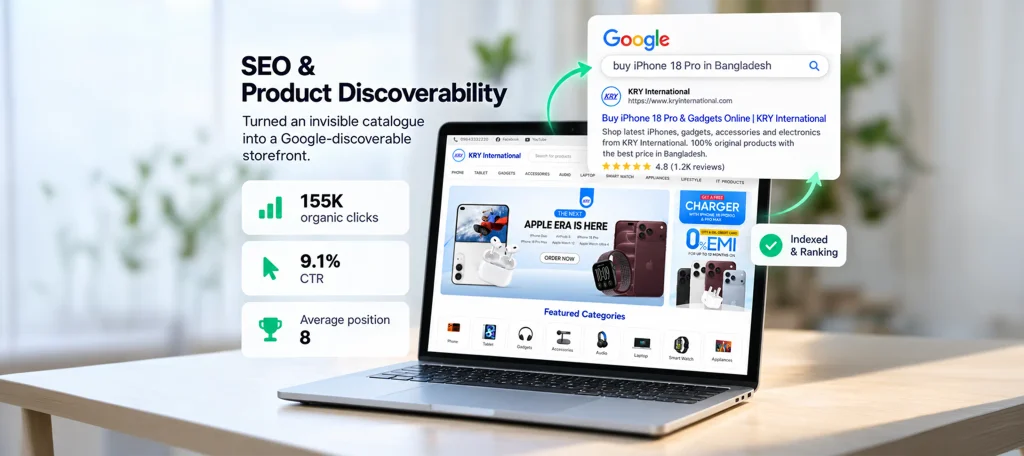
Problem. Google could not see the full catalogue, and customers who did arrive couldn’t search it properly.
What we built.
- A real-time, sharded, image-aware sitemap index that reflects the live catalogue.
- Typo-tolerant search and a dedicated results page.
- Canonical URLs, JSON-LD structured data and per-page SEO controls.
- Per-category and per-brand SEO content, with editable meta titles, meta descriptions and image alt text.
- A homepage SEO content grid, and blogs attached to product pages.
- An “Only Show Relevant Product” setting, so a browse through Phone, Samsung no longer lists TVs and monitors.
How it works.
- The sitemap is the map Google follows to find pages. Real-time means a new product or brand appears in it as soon as it exists. Sharded means it is split into several files, so a large catalogue stays manageable for crawlers. Image-aware means product images are listed too, helping them appear in image search.
- Canonical URLs tell Google which version of a page is the official one, so ranking signals aren’t split across duplicates.
- JSON-LD structured data describes products in a language search engines read directly, which is also the base for Google Shopping eligibility.
- The relevance setting filters results by what the shopper meant, not by every keyword match.
Marketing and sales effect.
- Every product, brand, sub-category and tag now has a chance to be indexed and found organically.
- Shoppers who search on-site reach a results page instead of a dead end, and the typo tolerance catches the misspelled brand and model names common in phone searches.
- The marketing team can control titles, descriptions, and alt text themselves, so SEO no longer waits for a developer.
- Relevant results keep high-intent visitors on the products they want.
6.3 Speed and reliability
Problem. Visibility brings traffic, and traffic exposes weaknesses. When a site goes down, ad clicks are wasted, and crawlers fail to fetch pages. For a business that depends on Meta and Google, reliability protects marketing spend directly.
What we built. A layered production stack:
- WebP image conversion and a persistent image cache
- Rate limiting
- A hardened deploy script
- Cloudflare edge caching
- Prometheus and Grafana monitoring
We also changed how admin updates reach the site: price and stock changes now go live in about 2 seconds, down from up to an hour.
How it works.
- Images are converted once into a lighter format, and the result is kept, instead of being re-encoded after every rebuild.
- Rate limiting stops any single source, such as an aggressive crawler, from consuming all the server’s capacity.
- Edge caching serves repeat requests from Cloudflare’s network, so most visitors never reach the origin server.
- The monitoring stack watches the system and raises alerts before customers notice a problem.
- The fast update path means a price change made in the admin portal does not wait for a long cache to expire.
Marketing and sales effect.
- Ad clicks are far less likely to land on an error page when traffic spikes.
- Crawl budget isn’t wasted on failed requests.
- Flash-sale pricing stays in sync. A marketer can change a price or mark an item out of stock and see it live almost immediately, which protects both revenue and customer trust.
- The 504 incident behind much of this story has its own sidebar below: 65,034 gateway timeouts, about 23,000 images re-encoding at once, and CPU near 104%.
6.4 Pricing and promotion integrity
Problem. In the original build, applying a discount overwrote the real price. When the offer ended, the original price was gone, and expired offers could freeze the homepage. Offers weren’t tied to products, so real campaign pages and urgency tools were impossible.
What we built.
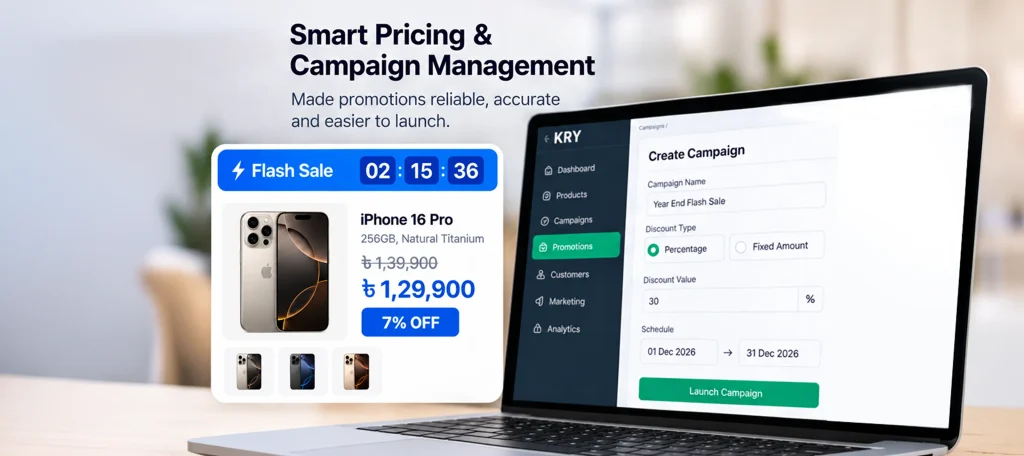
- Discounts became presentation metadata: a layer displayed over the real price instead of replacing it.
- Offers are linked to products, with correct start and end dates.
- Live countdowns appear on product and offer pages.
- Offer landing pages exist for campaigns such as KRY Friday Fest.
- One lowest-variant price helper is used across the whole site.
- Stock status became an admin setting.
How it works.
- The real price stays in the database unchanged. The discount sits on top, and when the offer expires, the display falls back to the real price automatically.
- Because offers are linked to products and carry start and end times, countdowns and landing pages can be generated from the same data.
- A single price helper means a product shows the same “from” price on the homepage, in search, and on its own page. Before, different parts of the site could calculate it differently.
- Stock status being an admin setting matters because “In stock” changed three times during the project, each time touching at least eight code paths. Turning it into a setting meant the next change needed no code (full story in the sidebars below).
Marketing and sales effect.
- Campaign pricing is trustworthy and reversible, which protects the brand’s credibility.
- Countdowns and offer pages give marketers real urgency mechanics for the first time.
- A clean, consistent price source is the foundation for future product feeds such as Google Merchant and Meta catalogue (roadmap items, not claims).
6.5 Conversion and UX
Problem. Visitors who wanted to buy met friction: a registration wall, no cart drawer and a tedious mobile experience.
What we built.
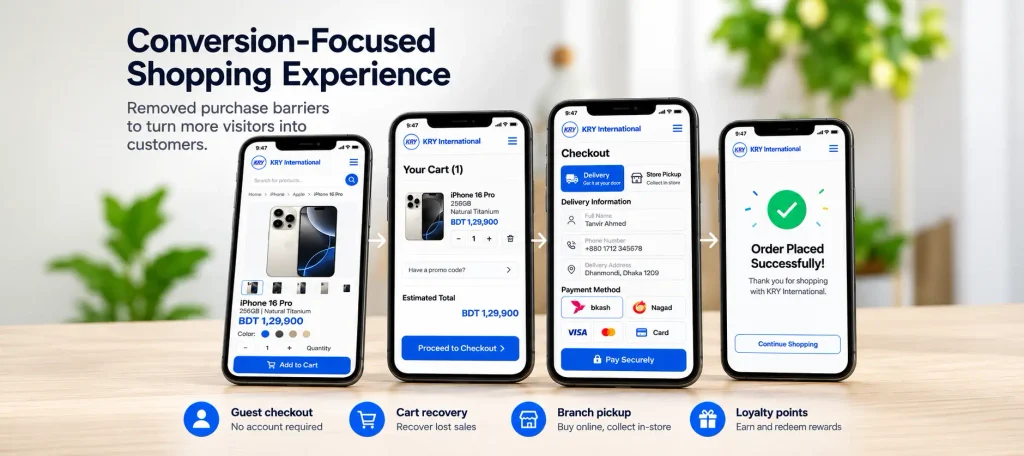
- Checkout: guest checkout, a cart drawer, OTP at checkout, Google login, branch pickup, a redesigned two-panel checkout, and purchase-with-points.
- Discovery and confidence: a compare tool (up to three products), a wishlist, product video and video reviews, recently viewed products, and cart-based “You May Also Like” recommendations.
- Interface: a rebuilt filter sidebar, mobile-specific imagery, and a Figma-based design system.
How it works.
- Guest checkout lets a customer buy without creating an account, and OTP verifies their phone number, which fits KRY’s phone-first customer identity.
- The cart drawer keeps shoppers on the page while they add items.
- Branch pickup connects the online store to KRY’s physical locations.
- Points let loyal customers pay partly with earned rewards, and the rules (such as the cap) are enforced on the server.
- The compare tool, video, and recommendations help shoppers make a high-value electronics decision with confidence.
- The Figma design system means components are reused consistently, so new pages look and behave the same.
Marketing and sales effect. Each feature maps to a funnel step: less friction at checkout, more confidence at the product page, and more reasons to add one more item at the cart. One early signal: to date, 20.22% of orders (396 orders) used points, while points-paid revenue was 0.03% of total revenue. That shows customers are using the feature, with a small share of revenue paid in points.
6.6 Omnichannel automation
Problem. Customers who left without buying, or who wanted an out-of-stock product, were lost. KRY had no systematic way to reach them again.
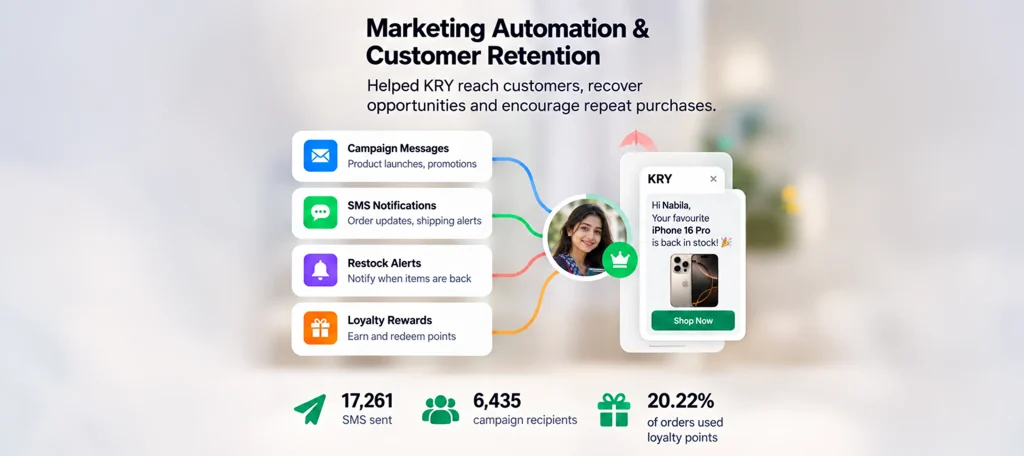
What we built. A single messaging engine that powers SMS and email, plus connections to Google, Meta, and chat channels.
| Channel | What exists | Automation | Status |
|---|---|---|---|
| SMS | OTP, restock alerts, cart recovery, campaigns | Auto-send on restock, editable templates, audience filters | Live |
| Same engine, per-purpose channel toggles | Same triggers | Live | |
| GA4, Search Console and Clarity in admin; sitemap; archive SEO | Event tracking | Live | |
| Meta Pixel | InitiateCheckout with value and currency, advanced matching | Event-based retargeting | Live |
| WhatsApp, Messenger, Call | Floating widget, product-page buttons, per-product WhatsApp number, admin-managed | Click-to-chat, tracked WhatsApp action | Live (manual replies) |
| Facebook login | Built | n/a | Pending Meta verification |
How it works.
- Restock alert: the product goes out of stock, the product page shows a “Notify Me” form, the customer submits their number or email, the admin restocks the item, and an SMS or email with the product link goes out (automatically, if auto-send is switched on). The customer returns and orders.
- Cart recovery: the customer adds items and leaves, the abandoned cart appears in the admin panel with the customer’s details, and the team sends an SMS or email from an editable template (or switches on auto-send). The customer returns to complete the order.
- Campaign send: the marketer builds a message in the campaign composer, the composer shows the live recipient count based on audience filters, and the message is sent from an editable template.
- OTP: checkout triggers an OTP by SMS or email, and the customer verifies before placing the order.
- Click-to-chat: the visitor taps WhatsApp, Messenger or Call on a product page, the click is tracked, and the team replies manually.
Marketing and sales effect.
- Recoverable revenue is no longer lost silently: restock alerts and cart recovery re-engage customers who had already shown intent.
- Per-purpose channel toggles let KRY control which messages go out on which channel.
- Meta’s InitiateCheckout event, sent with value and currency plus advanced matching, gives ad platforms the signal to retarget and optimise.
- Chat and call buttons meet customers who prefer to talk before buying, which is common for high-value electronics.
6.7 Marketing control panel
Problem. Every popup, banner, or notice required a developer and a deployment, which made campaigns slow and dependent on engineering.
What we built. A control panel for the marketing team:
- A popup manager, set by page, and shown once, once per session, or on every load.
- A top bar notice with countdown and call to action.
- An Appearance drawer with mobile sliders.
- A campaign composer with a live recipient count.
- Configuration switches for guest checkout, coupons, pickup, points, OTP and stock rules.
How it works. Everything is managed from the admin portal. The marketer chooses where and how often a popup appears, sets a notice with a countdown, adjusts the look of the mobile homepage, and composes a message while seeing how many people it will reach. The switches let the business turn features on or off without code.
Marketing and sales effect. Routine campaigns no longer need a deployment. This is the structural change: campaign speed now depends on the marketing team, not on developer availability. It also lets KRY respond quickly to a competitor’s offer or a stock change.
6.8 Analytics and data visibility
Problem. The business could not see its own numbers, and ad platforms were receiving incomplete data.
What we built.
- Admin Analytics that combines GA4, Search Console, and Clarity.
- A Sales Report with period comparison.
- Purchase Point revenue share.
- Additional event listeners for Meta Pixel and GA4.
How it works. The data a manager needs is gathered in one admin view, and the added event listeners record important actions, such as starting a checkout, so Pixel and GA4 receive them with proper values.
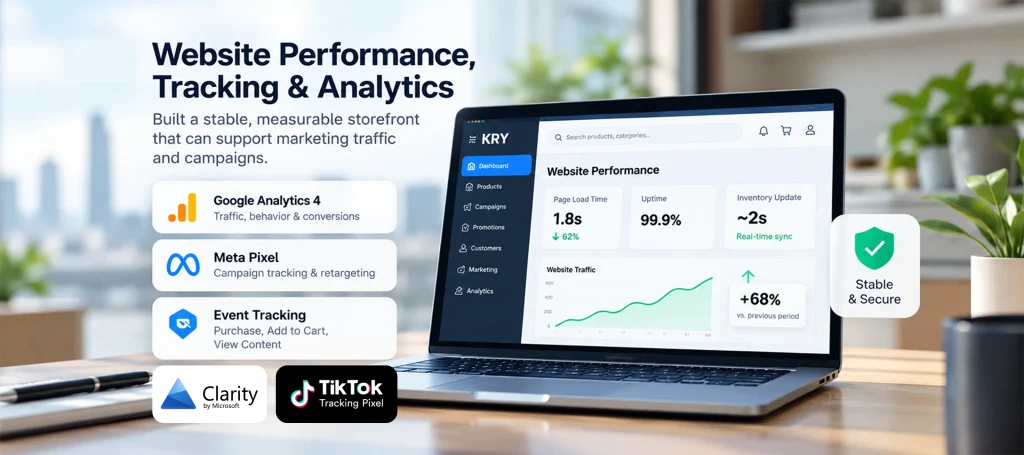
Marketing and sales effect. The business can now see its own numbers, and ad platforms get better data. Marketers can compare periods, judge campaigns, and see how much revenue comes from each purchase point. Ad platforms get the events they need to optimise targeting.
6.9 Social and Google visibility
Problem. A store that depends on discovery needs more entry points than search alone.
What we built.
- Social profiles linked (Facebook, Instagram, YouTube, TikTok).
- Product video for content.
- Blog integration.
- A branch locator for local discovery.
Marketing and sales effect. Product videos and blogs give social and search channels shareable content. The branch locator helps customers searching for a nearby store and ties the online store to the physical branches.
Customer Journey: Before and After
The clearest way to see what the work changed is to follow one shopper through the store. The shopper below is illustrative.
Before: where the journey broke
Step 1: Finding the product. Shaon searches Google, but KRY’s incomplete sitemap means not every product page is surfacing. If she lands on the store and types her query into the search box, pressing Enter does nothing, because there is no results page.
- Sales effect: a high-intent visitor is lost before she has seen a single product.
- Customer effect: she assumes the site is broken, or the product doesn’t exist, and goes elsewhere.
Step 2: Choosing the product. If she reaches a product page, the price she sees may not be reliable. Discounts have overwritten real prices, and expired offers could freeze the homepage. There are no countdowns or offer pages, so nothing tells her whether a deal is real.
- Sales effect: wrong or untrusted prices cost sales and credibility, and campaigns can break the site when it is busiest.
- Customer effect: a customer spending serious money on a device can’t tell whether the price is right, which weakens KRY’s “100% authentic” promise.
Step 3: Buying the product. To order, she must register first. There is no cart drawer, and the experience was not built for the phone she is holding.
- Sales effect: checkout drop-off, especially on a mobile-first audience.
- Customer effect: a long form on a small screen, before she has even paid.
After she leaves. There is no abandoned-cart message, no back-in-stock alert and no campaign to bring her back.
- Sales effect: recoverable revenue is lost for good.
- Customer effect: nothing reminds her, and nothing tells her the product she wanted is available again.
After: the same journey, rebuilt
Step 1: Finding the product. The sharded, real-time sitemap and the SEO controls give every product, brand, and sub-category the chance to be indexed. On the store, search tolerates typos and opens a dedicated results page. With “Only Show Relevant Product” on, browsing Phone, Samsung returns phones, not TVs and monitors.
- Sales effect: high-intent visitors reach products instead of dead ends.
- Customer effect: she gets what she meant, even if she misspells a model name.
Step 2: Choosing the product. She lands on a correctly priced page. The real price is preserved, with any discount layered on top, and live countdowns and offer pages, such as KRY Friday Fest, show when a deal ends. She can compare up to three products, watch product video, read video reviews, and see related items from the cart.
- Sales effect: trustworthy campaign pricing, plus urgency and confidence tools that support higher-value purchases.
- Customer effect: she can verify the price and compare options without leaving the page.
Step 3: Buying the product. She opens the cart drawer, checks out as a guest and verifies her phone number with an OTP. She can pay by cash on delivery or through SSLCommerz, choose branch pickup, or use points if she has them.
- Sales effect: the registration wall is gone, and the funnel has fewer places to quit.
- Customer effect: a short, phone-friendly checkout built around her phone number, the identity she actually uses.
After she leaves, or if she wants a product that’s sold out. Now KRY has ways to reach her again. If she abandons her cart, the team can send a reminder to bring her back. If the product was out of stock, she can submit a Notify Me form and get an SMS or email with the product link when it is restocked. KRY’s team can also reach her through campaign messages, composed with a live recipient count.
- Sales effect: intent that used to disappear can now be recovered, and the business can re-engage by cart, restock, and campaign.
- Customer effect: she is told when something she wanted is available, instead of having to keep checking.
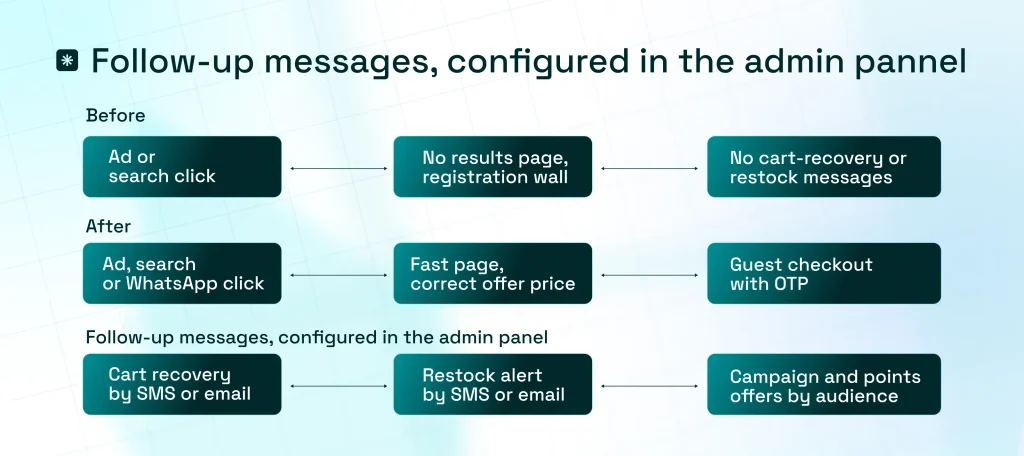
Customer journey before and after · 3 steps each, plus follow-up messages
Before, a visit could end at a missing search page, a registration wall, or with no follow-up. After, the visitor reaches a correctly priced page, orders as a guest with OTP, and can be re-engaged by cart, restock, and campaign messages.
Signature Story Sidebars
Sidebar 1: The 504 outage
What happened. A routine container rebuild wiped the store’s image cache. When visitors and crawlers began requesting product pages, the server had to rebuild its images from scratch. About 23,000 product images were queued for AVIF encoding, a demanding image format, at the same time. CPU usage pinned near 104%, and the site began returning gateway timeouts. In total, 65,034 requests failed with a 504.
Why it mattered. A 504 is an outage the customer sees as “the store is down.” For KRY, a failure like this has marketing costs. Ad clicks land on an error page and are paid for anyway. Search crawlers fail to fetch pages, which wastes crawl budget. Nothing in the setup could have warned the team, because there was no monitoring: the only visibility was the failures themselves.
What we did. We fixed it in layers, because no single change would have been enough:
- WebP images instead of heavy AVIF encoding, so conversion costs far less CPU.
- A persistent cache volume, so a rebuild no longer throws away converted images.
- Rate limiting on image requests, so no single source can consume the server’s capacity.
- A hardened deploy script that validates configuration and pre-warms pages before purging the CDN.
- Cloudflare edge caching, so most repeat requests never reach the origin server.
- Prometheus and Grafana monitoring, with alerts, so the team sees trouble before customers do.
The lesson. The cause was a chain, not a single mistake: a rebuild, an empty cache, an expensive encoding format, and unlimited concurrent work. The fix was a chain too. Monitoring replaced “no visibility at all” with dashboards and alerts.
Sidebar 2: Discounts that overwrote prices
What happened. In the original build, applying a discount changed the product’s actual price. The old price was gone. When a campaign ended, there was nothing to restore. Expired offers could also freeze the homepage, leaving the store broken in the middle of a promotion.
Why it mattered. A retailer that runs frequent offers needs every campaign to be safe to start and safe to stop. Here, ending a sale was riskier than starting one. It also blocked everything built on top of offers, such as countdowns and landing pages, because offers weren’t properly tied to products.
What we did. We changed what a discount is. It became presentation metadata: a layer shown over the real price instead of replacing it. The real price now never changes when an offer is applied. Offers are linked to products with correct start and end dates, and when one expires, the display returns to the real price by itself. That same data now drives live countdowns and offer landing pages such as KRY Friday Fest.
The lesson. Campaign safety is a data-design decision. Once the price and the promotion were separate things, launching a sale no longer carried the risk of breaking the store, and a clean price source became available for future product feeds.
Sidebar 3: “In stock” changed three times
What happened. “In stock” sounds like the simplest thing a store can say. During the project, the business definition of it changed three times. Each change touched at least eight places in the code, among them product pages, listings, search, cart, and checkout, so every redefinition meant careful, repetitive work and a risk of one path being missed.
Why it mattered. A wrong stock label does real damage in retail. It either sells something that isn’t available or hides something that is. A rule that lived in the code made every business change a development task.
What we did. Instead of making a fourth code change, we turned stock status into an admin setting. The business can now decide how stock behaves (a simple in-stock tickbox, or the tickbox together with a stock quantity), and the code reads the setting. The same pattern, configuration over code, became the way we handled other business rules, such as the guest checkout, coupon, pickup, points and OTP switches in the control panel.
The lesson. When a requirement changes more than once, it is a signal that the rule belongs to the business, not the codebase. Making it a setting turned changing requirements from a cost into a feature.
Results
9.1 Search Console (28 June to 27 September 2026)
Over the three months to 27 September 2026, KRY’s store recorded:
| Metric | Result |
|---|---|
| Clicks | 155K |
| Impressions | 1.7M |
| Average CTR | 9.1% |
| Average position | 8 |
An average position of 8 means KRY’s pages typically appeared on the first page of Google results. A 9.1% CTR means roughly one in eleven impressions turned into a visit.
What the trend shows. Reading the chart across the period, impressions fell by roughly 60% while clicks fell by roughly 25%. Because clicks fell much less than impressions, the daily click-through rate rose from about 7% to about 13%. In plain terms: Google showed KRY’s pages to fewer people, but a much larger share of those people clicked. These are approximate readings from the chart, and clicks also declined over the period.
9.2 Automation and engagement
Messaging.
- 17,261 SMS sent, as shown by the admin panel’s SMS counter (not broken down by message type).
- A campaign audience of 6,435 users, as shown by the campaign composer’s recipient count.
Points. To date:
- 20.22% of orders used points: 396 orders
- 80,810 points redeemed
- Points-paid revenue was 0.03% of total revenue
9.3 Business KPIs
| KPI group | KPI | Result |
|---|---|---|
| Marketing | Organic clicks, CTR and position | 155K clicks, 9.1% CTR, position 8 (28 Jun to 27 Sep) |
| Marketing | Campaign launch time | Before: a developer request and a deployment. Now: no deployment needed |
| Sales | Points-assisted orders | 20.22% of orders (396 orders), to date |
| Sales | Guest checkout | Available; registration is no longer required to buy |
9.4 Before and after summary
| Before | After |
|---|---|
| 183 latent security and correctness defects | Systematically audited and fixed |
| Sitemap leaking debug URLs | Sharded, real-time sitemap; typo-tolerant search |
| Outage risk under crawler load | Edge-cached, resource-capped, monitored production stack |
| Discounts overwriting real prices | Offers as presentation metadata |
| Mandatory registration to buy | Guest checkout, pickup, points, OTP and coupons, all admin-toggleable |
| Scattered, hard-coded UI | Figma-based redesign with a reusable component system |
| No visibility into site health | Dashboards and alerting; about 2 seconds for admin changes to go live |
Challenges and Lessons
No project of this size runs smoothly, and the honest parts are often the most useful. These are the lessons that changed how we build, each one earned on this project, and each one a rule we’d now apply to any store.
Lesson 1: Enforce business rules on the server, never the client
The challenge. Several of KRY’s commercial rules are the kind customers are tempted to test: the cap on how many points can be used, the pickup fee, and which coupons guests may apply. If the page itself decides what is allowed, anyone who can change what their browser sends can get around the rule.
What we did. We made the server the only authority. The browser can show a points balance, a pickup fee or a coupon field, but the server recalculates and validates every one of them when the order is placed. If the numbers sent don’t match the rules, the order doesn’t go through that way.
Why it matters commercially. Points, fees and coupons are money. A rule that can be bypassed is a discount that can be taken without permission. This is the same principle behind the payment-integrity work: what the customer’s screen shows is a display, not a source of truth.
Lesson 2: Every caching layer needs its own invalidation plan
The challenge. Speed came from caching at several levels: converted images, edge caching at Cloudflare, and a fast path for admin updates. Each layer makes the site faster, and each can also serve something out of date. For a store that changes prices and stock, a stale page is a real problem, since a customer could see a price that no longer applies.
What we did. We planned how each layer is refreshed before relying on it. The result is visible in one number: admin price and stock changes now reach the live site in about 2 seconds, where they could previously take up to an hour.
Why it matters commercially. Caching protects the site during traffic spikes, but a sale price that appears an hour late, or a sold-out product that still shows as available, costs money and trust. The 504 incident above shows what happens without caching and without a plan. This lesson is the other half of that story.
Roadmap
The roadmap is built on that foundation. It covers what comes next and, just as importantly, what we haven’t yet confirmed as live. Each item below solves a specific marketing problem and builds on something already in place.
11.1 Omnichannel: closing the loop between channels
Why it matters. KRY sells across the website, branches, and social platforms, and relies heavily on Meta and Google. Today the messaging engine, the Pixel events and the chat buttons are live. The next step is connecting inventory, ad platforms, and shopping feeds so every channel works from the same data.
| Item | What it would do | Builds on |
|---|---|---|
| POS and inventory real-time sync | Branch sales and online stock update each other, so a product sold in a branch can’t be oversold online. | Centralised inventory and the stock-status setting |
| Meta catalogue and Conversions API | Products flow into Meta’s catalogue for dynamic ads, and purchase events are sent from the server, not only from the browser. | Clean pricing data and the live Pixel events |
| WhatsApp automation and templates | Moving from click-to-chat with manual replies to automated, template-based messages such as order updates and restock alerts. | The existing messaging engine and the tracked WhatsApp action |
| TikTok pixel and shop feed | Tracking and product listings for TikTok, where the profile is already linked. | Product video and the clean product data |
| Google Merchant feed | Products listed in Google Shopping and available for ads. | Validated product schema and consistent pricing |
11.2 AI: from smart features to personalised ones
Why it matters. The store already behaves intelligently in small ways: typo-tolerant search, cart-based suggestions and recently viewed items. The requirements document sets out deeper AI use for later phases, and it depends on the data foundation now in place: clean event tracking and unified guest and registered customer records.
- Product recommendations that learn from browsing and purchase behaviour.
- A personalised homepage that changes with the visitor.
- A chatbot for common pre-sale and after-sales questions.
- AI content support for descriptions, SEO fields and campaign copy, with human review.
Marketing effect. Higher relevance for each visitor, lighter load on the sales and support team, and faster content production.
11.3 Search and content: reaching customers in their own language
Why it matters. A Bangladeshi audience searches in Bangla, in English and in “Banglish” (Bangla written in Latin letters). Search visibility so far rests on English-language SEO, and there is room to grow.
- Bangla and Banglish search, so on-site search understands how customers actually type.
- Review schema, so ratings can appear in Google results.
- Video SEO, so product videos can surface in search.
- Core Web Vitals monitoring, to track speed and stability continuously against Google’s own measures, building on the monitoring already in place.
Marketing effect. More organic discovery, richer search listings, and a speed advantage that is measured, not assumed.
11.4 Retention: turning first orders into repeat customers
Why it matters. Points are already in use, with 20.22% of orders using them to date, but they are a single mechanism. Retention is the cheapest growth for a retailer.
- Loyalty tiers that reward repeat customers with more benefits.
- One-click re-order for accessories and consumables.
- Referrals, so satisfied customers bring in new ones.
Marketing effect. Higher lifetime value per customer, more repeat orders, and lower acquisition cost through referrals.
11.5 Data: knowing which customers and channels are worth the most
Why it matters. The business can now see its own numbers, and ad platforms receive better events. The next step is making the data more complete and more useful.
- Server-side tracking, so key events are recorded reliably even when browsers block scripts.
- Customer lifetime value segments, to see which customers and sources are worth the most over time.
- Offline-to-online attribution, to connect branch sales with the digital activity that led to them.
Marketing effect. Better ad optimisation, smarter budget decisions, and the first real view of how the online store and the branches work together.
Planning your next digital project?
We build premium websites designed for businesses, agencies, startups and consulting professionals.