
Digital marketing is shifting rapidly as conversational AI changes how consumers research products and services online. For years, Google Ads has served as the default PPC platform for reaching buyers with active search intent. Today, emerging opportunities like ChatGPT Ads present a fundamentally different way to connect with audiences during their evaluation and decision-making processes.
Determining which is better, ChatGPT Ads or Google Ads, depends on campaign goals, market availability, target audience behavior, budget, and measurement requirements. This guide compares both advertising channels to help your business make an informed strategic decision.
What Are Google Ads?
Google Ads is an established online advertising platform built around search intent, display networks, and video channels. It allows businesses to bid on user search queries, place visual banners, and run video ads across a massive global ecosystem.
Key advertising formats within Google Ads include:
- Search Ads: Text placements appearing on Google Search result pages when users type specific keywords.
- Shopping Ads: Product listing ads featuring images, prices, and merchant names, powered by Google Merchant Center.
- Display Advertising: Visual banner ads placed across millions of websites and mobile apps within the Google Display Network.
- YouTube Advertising: Video ad formats targeting users based on viewing habits, search history, and channel categories.
Businesses use Google Ads to capture existing demand at the exact moment a prospect searches for a solution.
What Are ChatGPT Ads?
ChatGPT Ads represents OpenAI’s advertising ecosystem. It displays clearly labeled sponsored placements below ChatGPT responses for eligible users.
To evaluate this channel accurately, businesses must distinguish between three distinct concepts:
- Paid ChatGPT Ads: Sponsored ad units managed via OpenAI Ads Manager that display below chat responses.
- Organic AI Mentions (GEO): Visibility within ChatGPT’s generated text answers, which is managed through Generative Engine Optimization and is entirely independent of paid ads.
- AI Content Marketing: Using artificial intelligence tools internally to draft ad copy, landing pages, or marketing campaigns.
Verified Availability & Capabilities (2026)
According to official OpenAI updates, self-serve access via OpenAI Ads Manager expanded to over 80 countries in 2026—including the USA, UK, Canada, India, European markets, and Bangladesh. Ads appear exclusively on Free and Go subscription tiers, while paid Plus, Pro, Business, and Enterprise accounts remain ad-free.
Targeting relies primarily on context hints—plain-language descriptions of user tasks and conversation topics—rather than traditional exact-match keyword bidding. Because platform features, advertiser policies, and regional self-serve access continue to evolve, availability and account eligibility should always be confirmed at ads.openai.com before finalizing budget plans.
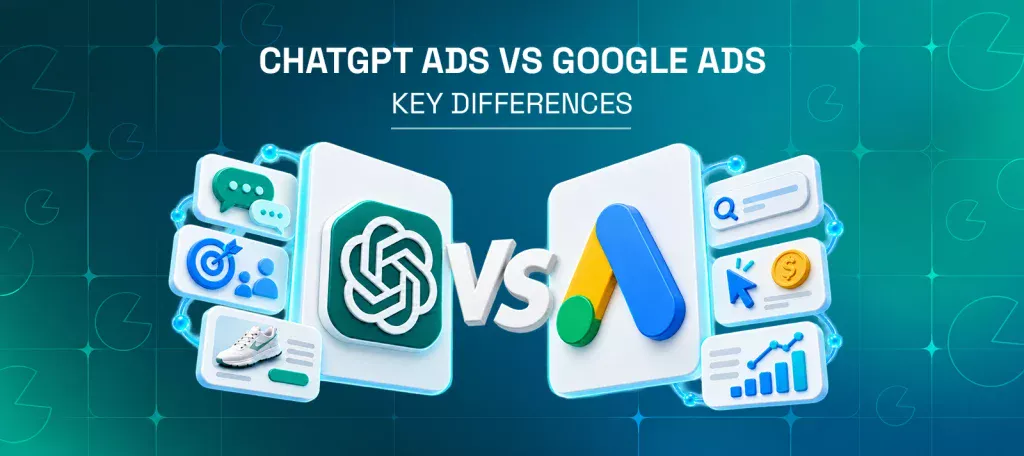
ChatGPT Ads vs Google Ads: Key Differences
Comparing Google Ads vs ChatGPT Ads requires evaluating established search mechanics against conversational AI environments.
| Feature / Criterion | Google Ads | ChatGPT Ads |
| Platform Environment | Search Engine Results Pages (SERPs), YouTube, Display Network, & Maps. | Conversational AI chat threads on web and mobile apps. |
| User Discovery Intent | Query-based keyword searches (e.g., “buy CRM software”) | Goal-driven conversational exploration and product comparison. |
| Platform Availability | Globally available across virtually all countries and industries. | Available via self-serve Ads Manager in 80+ supported countries. |
| Targeting Mechanism | Keywords, negative keywords, demographics, interests, & placement sites. | Context hints (conversation topics), country, device platform, & custom audiences. |
| Ad Formats | Text ads, image cards, responsive search ads, video, & shopping feeds. | Labeled sponsored cards below responses featuring title, copy, image, & link. |
| Pricing Model | Bidding via CPC, CPM, CPA, or Target ROAS. | Bidding via Views (CPM), Clicks (CPC), or conversion-optimized CPC (oCPC). |
| Measurement & Analytics | Deep integration with Google Analytics 4, Tag Manager, & offline conversions. | OpenAI Measurement Pixel, Conversions API, & standard UTM parameters. |
| Ad-Free User Options | Third-party ad blockers only; ads show to all searchers by default. | Paid subscribers (Plus, Pro, Enterprise) see zero ads by default. |
Which Platform Is Better for Different Business Types?
No single platform fits every business strategy. The right option depends on your industry vertical and sales funnel structure.
E-commerce Businesses
Google Ads remain essential for e-commerce brands because of Google Shopping feeds and high-intent commercial search traffic. However, ChatGPT Ads for e-commerce offer strong potential when users ask conversational questions like “what are the best lightweight running shoes for marathons?” Sponsored product placements beneath those recommendations capture buyers during active product evaluation.
SaaS and Technology Companies
Software companies thrive on Google Ads by targeting direct category keywords (e.g., “best project management tool”). Emerging AI advertising channels allow SaaS brands to target users asking ChatGPT how to solve specific workflow challenges. Presenting a software solution right as a prospect defines their problem creates a compelling touchpoint.
B2B Companies
B2B buying cycles require trust, detailed positioning, and consistent lead capture. Google Ads excels at capturing high-intent B2B search queries. ChatGPT Ads for B2B companies complement this by reaching decision-makers who use AI to compare enterprise tools, outline vendor requirements, or draft project briefs.
Small Businesses
For small businesses with limited ad budgets, geographic targeting, simple setup, and immediate local leads are crucial. Google Search and Local Services Ads offer proven paths for local service providers. Small businesses considering ChatGPT advertising should confirm regional availability, test modest budgets, and align landing pages before scaling.
ChatGPT Ads vs Google Ads: Cost and ROI
Comparing campaign costs between platforms requires analyzing your overall customer acquisition cost (CAC) and return on ad spend (ROAS).
- Advertising Budgets: Google Ads allows flexible daily budgets across diverse campaign types. OpenAI Ads Manager enforces daily or lifetime minimums that vary by currency and target country.
- Cost Per Click (CPC): Google Ads CPCs vary widely based on keyword competition—ranging from a few cents to over $50 for competitive legal or financial terms. In ChatGPT Ads, bid pricing operates via a second-price auction, with OpenAI suggesting starting CPC bids around $3 to $5 USD depending on competitive dynamics.
- Conversion & ROI Expectation: Google Ads delivers direct conversion tracking built on decades of attribution infrastructure. ChatGPT Ads reporting relies on pixel events, server-side CAPI, and custom UTM parameters.
Neither platform automatically guarantees a lower CPC or higher ROI. Campaign profitability depends on creative relevance, landing page conversion rates, and clear tracking.
Can Businesses Use ChatGPT Ads and Google Ads Together?
Yes. Modern digital marketing strategies perform best when channels work together rather than in isolation.
Combining AI advertising vs traditional PPC creates a comprehensive customer acquisition strategy:
- Maintain Demand Capture: Keep Google Ads running to capture active search traffic for branded and high-intent keywords.
- Test Conversational Touchpoints: Allocate a portion of your paid media budget to test ChatGPT Ads when account access is available.
- Align Landing Pages: Use consistent messaging and dedicated, fast-loading landing pages across both channels.
- Implement Unified Tracking: Track leads and purchases via GA4 and server-side conversion pixels to measure real business impact.
Which Advertising Platform Should Your Business Choose?
Use this decision framework to select the right channel:
- Choose Google Ads if: You need immediate access to global search traffic, rely heavily on Google Shopping feeds, require local map pack visibility, or need complex keyword-level control.
- Evaluate ChatGPT Ads if: Your business is based in an eligible self-serve region, your prospective buyers use AI for product research, and you have established tracking infrastructure ready for testing.
- Combine Both if: Your business has stable customer acquisition on traditional paid search and wants to capture early-mover advantages in conversational AI search.
- If ChatGPT Ads are Unavailable: Focus on Google Ads while optimizing your website content for organic AI discovery (GEO).
Final Verdict
There is no universal winner between ChatGPT Ads vs Google Ads. Google Ads remains the undisputed leader for search engine intent and broad channel reach. Meanwhile, ChatGPT Ads provides an innovative, context-rich environment to reach consumers during deep research and evaluation moments.
Selecting the right advertising channel requires aligning campaign objectives with verified platform access, target audience habits, and measurable ROI.
Need help choosing the right advertising strategy for your business? Contact our team to discuss your goals and explore the options currently available to you.