
Client Overview
| Client Name | Global Vision BD |
| Type | International Education & Study Abroad Consultancy |
| Services | Student Visa, Visitor Visa, Spouse Visa, Immigration Visa, Language Courses, Travel Section |
| Destinations | UK, USA, Canada, Australia, Malaysia, Germany, Netherlands, France, Cyprus, Dubai & more |
| Website | globalvisionbd.com |
| Platform | WordPress + Elementor (Figma-designed) |
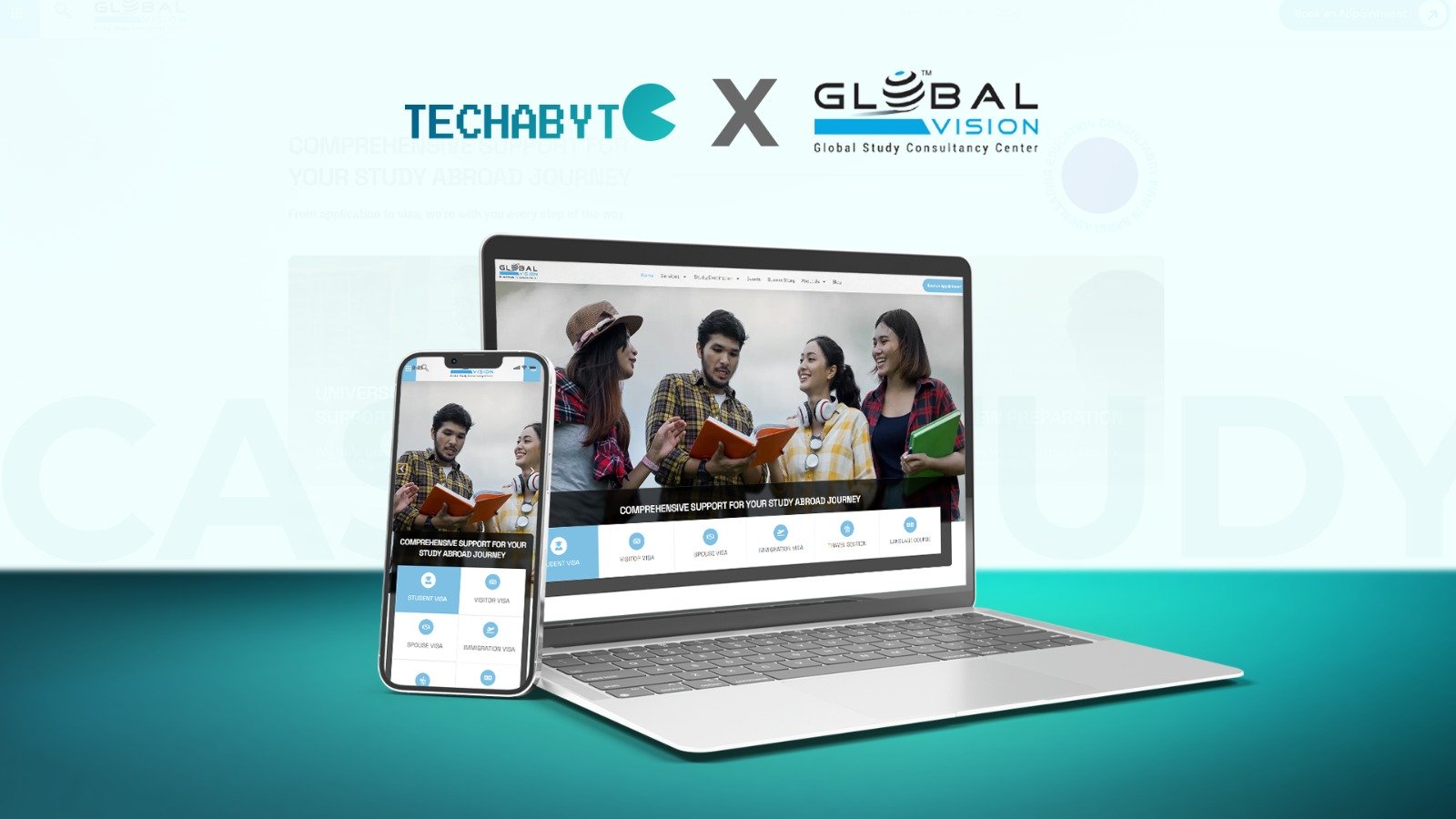
Global Vision is a Dhaka-based international education consultancy that takes students and families through the entire process of studying or migrating to a foreign country, including initial counseling and university applications, visa processing, and pre-departure preparation. The agency has a broad scope of student profiles and visa types, operating in over ten study destinations.
Before this project, Global Vision primarily used social media and word-of-mouth as its outreach methods. They lacked a dedicated site that could professionally showcase their entire portfolio of services and destinations or provide prospective students with a trusted online starting point.
The Brief
Global Vision required a professional, full-fledged site that would serve as the main digital identity of the agency, which parents and students could locate, trust, and utilize to get to know the entire offering of the agency. The client desired that prospective students could be able to research study destinations, know what services are available, and be able to book a free consultation all under one roof.
Key requirements from the initial brief:
– A clean, trust-building design suited to an education and consultancy brand
– Individual service pages: Student Visa, Visitor Visa, Spouse Visa, Immigration Visa, Travel Section, Language Courses
– Individual pages for each study destination — covering 12+ countries and regions
– A Success Story section to showcase real student outcomes
– Events and Webinar section for upcoming education fairs and seminars
– A free consultation/appointment booking form with service and destination selection
– Mobile responsiveness across all screen sizes
– University partner network logo display
– Blog section for visa updates and study abroad news
– Social media integration across Facebook, Instagram, YouTube, LinkedIn, X, and Pinterest
This was a ground-up construction. The client did not have a website, no design system in place, and no prepared content structure.
Challenges
No Existing Design System
Global Vision had no color palette, typography scale, or library of visual components, but had a logo. Every design choice was to be made afresh and in a tone that was both professional and trustworthy – attributes that are important to students and families making high-stakes decisions about studying abroad.
High Volume of Structured Content
The site had to have 12 or more study destinations and 6 service categories on individual pages. The creation and maintenance of this amount of pages would have been unmanageable without a smart content architecture, both in the development and after handover. Any change to a shared section (say, a country overview layout) would have to be done manually on all the corresponding pages.
Client Content Management After Handover
The agency team had to be able to publish blog posts, add new success stories, update event listings, and add destination content independently over time without having to have a developer involved with every change. Developing this flexibility in the site during its initial design, without altering the structure, was a fundamental requirement.
Feature Scope Within a Short Timeline
The entire need, which included events management, showcases of student success, a booking form, a partner carousel, a blog, and 25+ pages, had to be completed within 2-3 weeks. To achieve this deadline, efficient planning, a design-first approach, and reusable page structures were necessary.
Design Process — Figma First
The website was created in Figma before the first page was built in WordPress. This design-first approach was a conscious choice that shaped the quality and efficiency of all that came after.
Why Figma Before WordPress
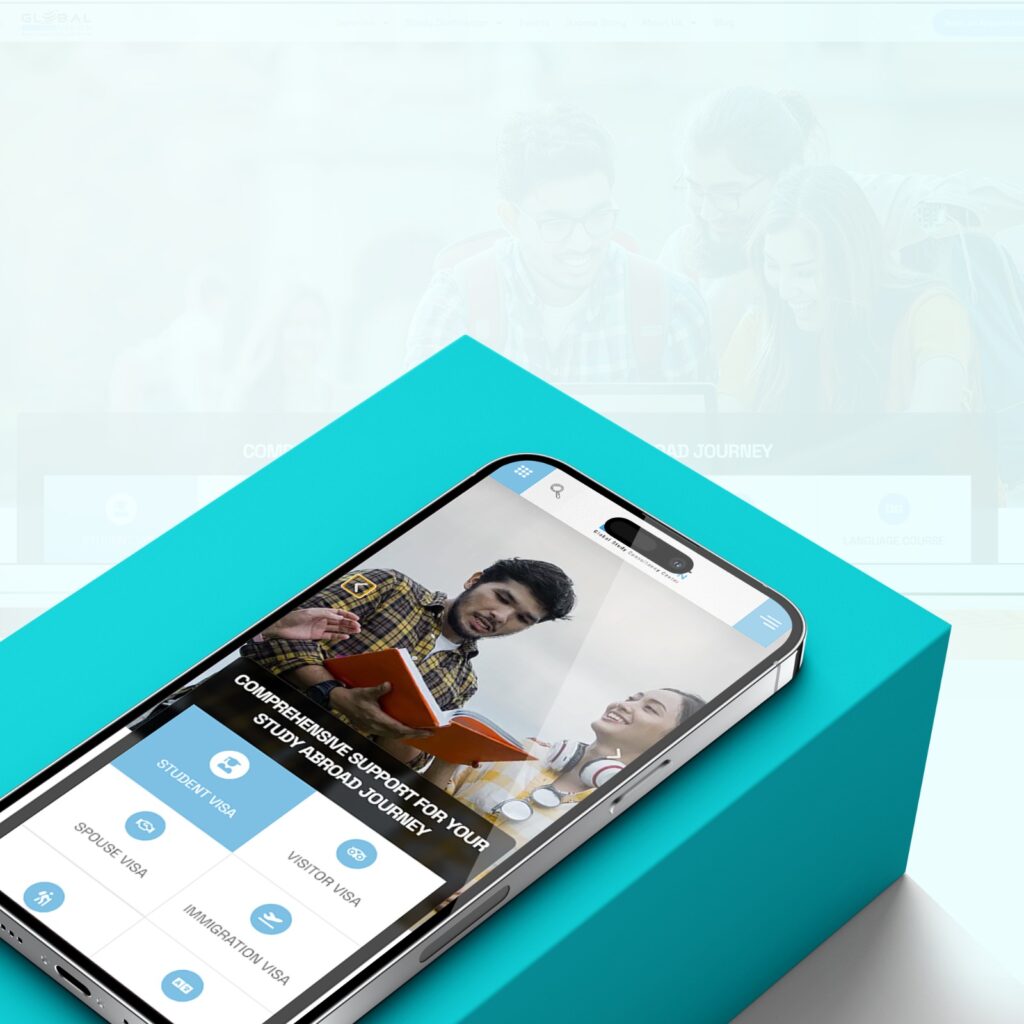
An education consultancy website needs to build trust at a glance. Getting Visual direction, right before the beginning of development, instead of making design choices within the page builder, ensured that layout, color, spacing, and hierarchy were all determined and client-approved before a single build work began. Figma designs are much quicker to update than live Elementor pages, which maintains the feedback loop clean and the development stage focused.
What Was Designed in Figma
– Homepage layout: Hero section, services overview, study destinations grid, why choose us, our process, partner logos, success stories, events strip, consultation CTA
– Service page template: reusable layout for all 6 service categories
– Destination page template: reusable layout for all 12+ study destinations
– Navigation structure: desktop mega-menu and mobile navigation
– Color palette: deep navy, accent blue, and supporting tones drawn from the Global Vision brand
– Typography scale: heading hierarchy, body text, button labels, and caption styles
– Card components: success story cards, service icon cards, destination flag cards, blog post cards
– Footer layout with navigation columns, social links, and newsletter field
Client Review in Figma
The entire Figma prototype was provided to the client to review, and then development started. Any visual direction feedback (color, layout, component style, and section order) was gathered during one round and integrated into the final design. This avoided mid-build design changes, which would have been much more time-consuming to make within Elementor, and guaranteed the client complete visibility prior to any code being written.
Figma to Elementor
After design approvals were made, the Global Style settings in Elementor were set up to match the Figma design system precisely – font sizes, color values, button styles, and spacing. This ensured the consistency of the translation between design and live page throughout the 25+ pages and greatly minimized the inconsistencies in styling in the build phase.
Technology Stack
| Figma UI Design & Prototype | WordPress CMS Platform | Elementor Page Builder | Custom CSS Styling & Overrides | WP Plugins Forms, SEO & More |
WordPress was chosen as the CMS due to its flexibility, wide hosting support, and most importantly, capability to be operated by a non-technical team once handed over. The Figma designs were translated into live and responsive pages with Elementor Pro. Elements that Elementor did not have adequate native controls were also written in custom CSS, such as the hero section animation, the hover state of the navigation, card elements, and the partner logo scroll strip.
Solving the Content Management Problem
The amount of structured content was one of the biggest technical issues on this project, and the fact that this content would continue to expand and evolve. Global Vision required 12+ study destinations, 6 types of services, student success stories, blog posts, and events. All types of content were structured consistently: a destination page always includes an overview, entry requirements, and a section with highlights of the study; a success story always includes a student’s name, university, and outcome.
Building each of these pages as a single, hand-built layout would have posed two significant issues to the client:
– Each time a developer needed to add a new destination or success story, he had to create a new page.
– In case the client desired to change the design of success story cards or destination pages, each page would have to be changed separately.
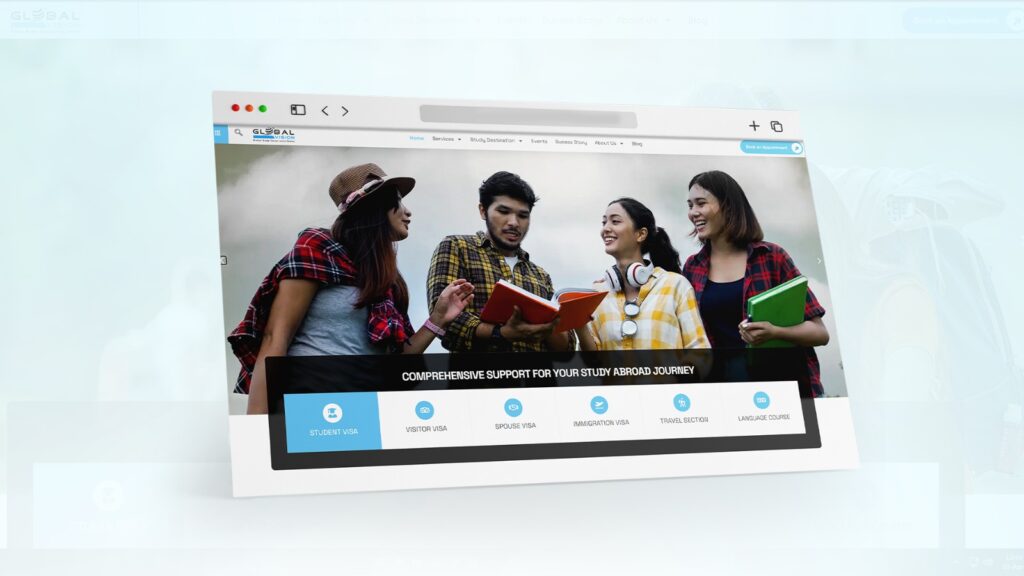
To address this, we developed a structured content system with each content type of destinations, services, success stories, blog posts, and events established as a managed content category within WordPress. The layout templates of each category are predefined and constructed in Elementor and used in all entries of the same type.
| Client Pain Point | How We Solved It |
| Each time a new country page was to be added, a complete page had to be constructed. | Destination pages share a common layout template – when a new country is added, it does not require a page to be recreated, just the content filled in. |
| There was no uniform structure in student success stories – the presentation was not even. | Success stories are treated as a special content type that has a specific card layout that is automatically applied. |
| Each time, blog posts needed to be formatted separately, which was not consistent. | Blogs are written on a single post template – the team just writes, and the post structure and styling are done automatically. |
| Social media posts and easy-to-overlook buried events. | The site has a dedicated events section where they have a structured listing of the upcoming events, which keeps them visible. |
| Any design modification to a repeated section required hand editing. | Editing a template will change every page of that type at once – a single edit, consistency across the site. |
The real-life implication on Global Vision: the team can post a new success story, a new study destination, or even a visa update, all by themselves, simply by filling out a content entry form, without making any changes to the design or involving a developer. The site does not oppose the business but rather develops with it.
Development Process
Discovery & Figma Design (Day 1–4)
– Briefing session with client: services, destinations, target audience, tone
– Site architecture mapping: full page list, navigation structure, content categories
– Full UI design in Figma: homepage, service page template, destination page template, inner pages
– Client review of Figma prototype and consolidated feedback collection
– Design revisions and Figma sign-off before development begins
WordPress Setup & Global Styles (Day 5–7)
– WordPress installation and environment configuration
– Elementor Pro setup with Global Styles mirroring Figma design system (fonts, colors, buttons)
– Header and footer built as global templates
– Content category structure established for destinations, services, success stories, blog, and events
– Reusable section and card component templates built
Homepage & Core Pages Build (Day 8–12)
– Homepage: Hero, Services overview, Destinations grid, Why Global Vision, Process steps, Partner logos, Success stories, Events strip, Consultation CTA
– About Us page, CEO Message page, Contact page with inquiry form
– Consultation booking form with service and destination dropdown fields
Destination, Service & Content Pages (Day 12–15)
– All 6 service pages were built using the service page template
– All 12+ destination pages built using the destination page template
– The Success Stories section is populated with student outcome cards
– Events & Webinars section configured with upcoming listing layout
– Blog section live with post template applied
Review, Optimization & Launch (Day 16–18)
– Cross-device testing: mobile, tablet, and desktop across all pages
– Image compression and performance optimization
– SEO basics: page titles, meta descriptions, heading hierarchy, image alt attributes
– Client walkthrough, content corrections, and final approval
– Site go-live and post-launch verification
Pages & Features Delivered
| Category | Pages / Components |
| Core Pages | Home, About Us, CEO Message, Contact Us, Blog |
| Services (6 Pages) | Student Visa, Visitor Visa, Spouse Visa, Immigration Visa, Travel Section, Language Courses |
| Study Destinations (12 Pages) | USA, UK, Canada, Australia, Malaysia, Germany, Netherlands, France, Cyprus, Dubai, Europe, New Zealand |
| Engagement Sections | Success Stories, Events & Webinars, Free Consultation Booking |
| Content System | Managed blog posts, destination entries, success story cards, event listings — all staff-editable |
| Legal Pages | Privacy Policy, Terms of Service |
– Fully responsive across mobile, tablet, and desktop
– Partner university logo carousel on the homepage
– Consultation booking form with service and destination dropdowns
– Social media integration: Facebook, Instagram, YouTube, LinkedIn, X, Pinterest
– Newsletter subscription field in the footer
– All content sections independently manageable by agency staff post-handover
Smart Lead Capture — Getting the Right Enquiry Every Time
One of the practical problems Global Vision faced before the website existed was the quality of inbound enquiries. When potential students reached out through social media or WhatsApp, they often provided little context — no mention of which service they needed, which country they were interested in, or what stage they were at in their decision. This meant the counseling team had to spend significant time in back-and-forth follow-up messages just to understand what a student actually wanted, before any real conversation could begin.
This is a common but costly friction point for consultancy businesses: every unqualified or incomplete enquiry consumes counselor time that could be spent on students who are ready to move forward.
The Solution: A Service-Aware Enquiry Form
To solve this, we built an intelligent enquiry form system that adapts based on what the user selects. Rather than presenting a single generic contact form to every visitor, the form responds to the student’s intent in real time.
Here is how it works in practice:
– A student comes to the site to study in the UK and chooses ‘Student Visa’.
– Someone enquiring about a Tourist Visa sees different fields: date of travel, country of travel, reason for visit.
– A visitor wanting a Tourist Visa instead sees entirely different fields: travel dates, destination, purpose of visit.
– A visitor interested in a Spouse Visa sees yet other fields.
– All inquiries Global Vision receives are already classified by service and destination – no guesswork!
| Before: Generic Contact Form | After: Service-Aware Smart Form |
| Every enquiry looks the same: name, number, message. No context. | Each submission is pre-tagged: service type, destination, and student details included |
| Counselors spend 10–15 minutes per lead asking follow-up questions before the real conversation begins | Counselors open a submission already knowing what the student needs — the conversation starts from step two |
| Unqualified leads mixed in with serious enquiries: no way to triage at a glance | Leads are naturally segmented by service category, making prioritization straightforward |
| Students drop off from long, irrelevant forms asking for information that doesn’t apply to them | Students see only the fields relevant to their situation — shorter, focused, and easier to complete |
| No visibility into which service is generating the most interest | Submission data shows exactly which services and destinations are driving the most enquiries |
| The result: less time chasing incomplete enquiries, more time spent on students who are ready and a noticeably smoother intake process for the entire counseling team. |
Outcome
The Global Vision site was done and released within the stipulated 2-3 weeks. The agency now has a professional and scalable online presence that accurately reflects their services and destinations – and a content management system designed to expand with the business without the need to involve the developer to make routine updates.
| 25+ Pages Delivered | 12 Study Destinations | 6 Service Sections | 2–3 Weeks to Launch |
“We needed a site that would be trusted by students and parents at a glance. The end product is clean, user friendly and includes all that a potential student should know about us and what we can offer them.”
Global Vision — Client Feedback
Reflection
This project proved that the design stage and the content structure are the two most useful investments in a multi-page consultancy site, not the amount of time spent in the page builder. The Figma-first approach implied that all decisions in the development phase of the build were intentional, as visual and structural decisions were already made and accepted. This made the 2-3 week schedule possible without compromising quality.
The decision that will be the most valuable to the client in the long term is the structured content system. An agency such as Global Vision is continually adding new partners, new destinations, and new student success stories. A site constructed without this architecture would have soon become a maintenance nightmare. The site was constructed using it and is meant to expand with the business with minimum overhead.
WordPress + Elementor Pro is still a suitable stack to support this type of service-based business: visual enough to provide a refined output, flexible enough to support the page structure, and accessible enough to allow a non-technical team to handle the daily content creation process fully independently.
Interested in a similar project?
We design and build professional websites for consultancies, agencies, and service businesses.