
Organic SEO services basically include SEO strategies such as keyword research, competitor analysis, content creation & optimization, On-page SEO (content optimization, title tags, meta description, internal linking), Off-page SEO (brand mentions, link building, guest-blogging, outreach), technical SEO (optimizing site speed, crawl errors, URL structures, XML sitemaps, structured data), excluding paid campaign strategies. Unlike paid advertisements, which include targeting keywords using pay-per-click methods, organic SEO provides long-term, sustainable strategies to improve search rankings and visibility. Organic SEO services don’t take any budget for itself, apart from hiring freelancers, agencies or SEO studios to implement them.
Key Takeaways
- Organic SEO is great for sustainable traffic and brand credibility.
- Core services: technical SEO, on-page SEO, off-page SEO, content strategy, and analytics.
- Professional Organic SEO saves budget and improves conversion rate.
- Time to implement: Content rankings or optimization improvements typically appear in 3–12 months.
- Ethical practices: ensure compliance with search engines and future-proofing.
- AI and modern search trends require structured, user-focused, and authoritative content.
- Success metrics: Include organic traffic, search volume, scroll depth, keyword ranking, CTR, user sessions, conversions (key events), and backlinks.
- Choosing the right SEO service provider depends on expertise, budget, and project complexity.
Why Organic SEO Services Matter
Organic SEO is the cornerstone to gain a website’s online visibility on search engines. Hence the services are essential for a business to ensure all the strategies are in place to impact search rankings, backlink growth, domain authority, and get more traffic for conversion. Unlike paid ads, organic SEO streamlines traffic for a long time unless it is time to improve the content.
Here’s why investing in organic SEO services is essential:
1. Sustainable Long-Term Traffic
The greatest benefits of Organic SEO are that it is free, sustainable and offers long-term outcomes to a website depending on visibility, rankings, user experience and conversion. Organic SEO is also indefinitely sustainable unlike the paid advertisements, and therefore the flow of traffic will not dry up.
As an example, a properly positioned, original and highly focused blog post on high-intent keywords such as Top 10 Running Shoes with Ankle Support to Women can feature in the first search results, and specifically to women who are fitness enthusiasts. This means your content continues to bring in traffic and ultimately leads, without continuous ad spend.
2. Cost-Effective Compared to Paid Ads
While paid advertising (PPC) can provide immediate traffic, it often comes at a high cost per click, especially in competitive industries. Organic SEO services, on the other hand, focus on optimizing your website and content to rank naturally.
A study by HubSpot found that organic search drives 53% of website traffic, while only 15% comes from paid ads. Over time, organic SEO provides a higher return on investment (ROI) because the traffic and leads you earn continue to grow without proportional increases in cost.
3. Builds Trust and Credibility
Users trust organic search results more than paid ads. When your website appears at the top of Google’s search results, it signals authority and credibility in your industry.
For instance, a customer searching for “best SEO agency in USA” is far more likely to click on a top organic result than a paid advertisement. By appearing consistently in organic search results, your brand establishes itself as a trusted expert, which can lead to higher engagement and conversions.
4. Improves Brand Awareness
Even if users don’t click on your website immediately, appearing in search results repeatedly increases brand recognition. This is especially important for businesses that rely on repeat visits or referrals.
Organic SEO services help you target strategic keywords that align with your products, services, and audience’s needs. Over time, this builds top-of-mind awareness, making users more likely to choose your brand when they’re ready to buy.
5. Supports Lead Generation and Sales
Organic SEO isn’t just about traffic—it’s about attracting the right audience. By targeting keywords based on search intent, your website reaches users who are actively looking for the products or services you offer.
For example:
- Someone searching “affordable e-commerce website design in Bangladesh” is ready to hire a service provider.
- By optimizing for this keyword, your site is positioned to capture highly qualified leads, which can directly impact sales and revenue.
6. Provides Measurable Results
Professional organic SEO services come with analytics and reporting, so you can track your performance over time. Key metrics include:
- Organic traffic growth
- Keyword rankings
- Click-through rates (CTR)
- Leads and conversions
- Engagement metrics like bounce rate and dwell time
Unlike traditional marketing channels, SEO allows businesses to measure ROI accurately, adjust strategies, and continuously improve results.
7. Future-Proof Your Digital Presence
Search engines are constantly evolving, with AI and semantic search becoming more important. Investing in organic SEO services today ensures your website is optimized for both current and future search trends.
SEO isn’t a one-time task—it’s a long-term strategy. Businesses that invest early in organic optimization will be better positioned to maintain visibility even as algorithms change.
Core Components of Organic SEO Services
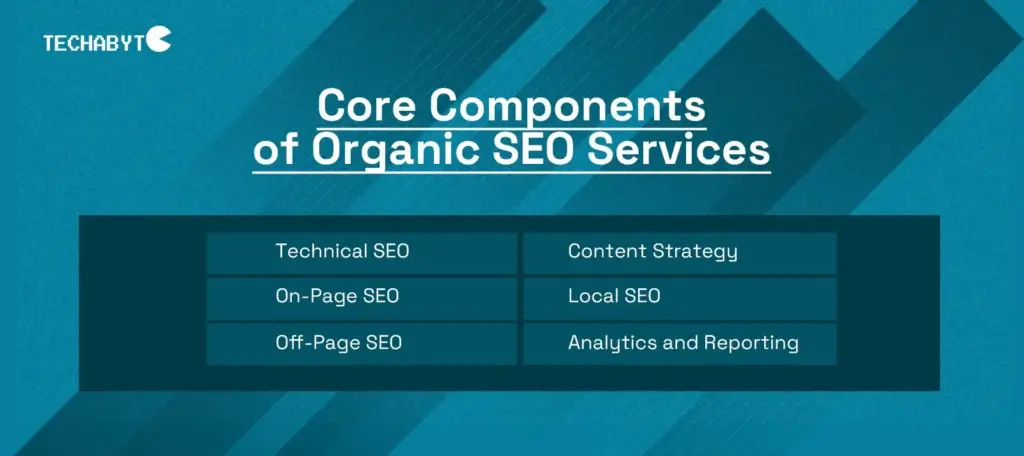
Organic SEO is a multi-faceted strategy that goes beyond simple keyword placement. To achieve sustainable rankings and traffic, businesses need to focus on several core components. Professional organic SEO services cover each of these areas systematically to maximize results.
1. Technical SEO
Technical SEO is the foundation of any successful organic SEO strategy. Without a technically sound website, even the best content may fail to rank. Key elements include:
- Website Structure and Crawlability: Search engines use crawlers to index your website. A clear, logical structure ensures all important pages are discoverable.
- Page Speed Optimization: Slow-loading pages lead to higher bounce rates and lower rankings. Optimizing images, caching, and reducing server response times is critical.
- Mobile Responsiveness: With mobile-first indexing, Google predominantly uses the mobile version of your site for ranking. Responsive design is essential.
- Secure Website (HTTPS): Security is a ranking factor and builds trust with users.
- Structured Data (Schema Markup): Helps search engines understand your content better and can generate rich results like star ratings, FAQs, and product details.
Impact: Technical SEO ensures your website is “search engine friendly,” forming the backbone for all other optimization efforts.
2. On-Page SEO
On-page SEO focuses on optimizing individual pages to target relevant keywords while providing a great user experience. Key elements include:
- Keyword Research and Search Intent Targeting: Identifying high-value keywords that your audience is actually searching for.
- Title Tags and Meta Descriptions: Crafting compelling titles and descriptions that improve click-through rates (CTR).
- Header Tags (H1, H2, H3): Structuring content for readability and semantic relevance.
- Content Optimization: Ensuring content is high-quality, informative, and aligns with search intent.
- Internal Linking and URL Structure: Helps distribute link equity and makes navigation easier for users and crawlers.
Impact: On-page SEO helps your pages rank for the right keywords and keeps visitors engaged once they land on your site.
3. Off-Page SEO
Off-page SEO involves building authority and trust for your website beyond its own pages. This mainly includes:
- Backlink Building: Acquiring high-quality, relevant backlinks from authoritative sites to signal trustworthiness to search engines.
- Digital PR and Outreach: Promoting your content to earn media mentions and links from credible sources.
- Social Signals: While indirect, social engagement can increase brand visibility and traffic.
- Reputation Management: Managing reviews and online mentions to maintain a positive digital footprint.
Impact: Off-page SEO tells search engines that your website is trustworthy, relevant, and authoritative in your industry.
4. Content Strategy
Content is the heart of organic SEO. High-quality, relevant content attracts, engages, and converts your target audience. Components include:
- Evergreen Content: Articles, guides, and blog posts that remain relevant over time.
- Topic Clusters and Pillar Pages: Organizing content around central topics to improve semantic SEO and internal linking.
- Blog Posts and FAQs: Answering common questions your audience searches for to capture long-tail traffic.
- Alignment with Buyer Journey: Creating content for awareness, consideration, and decision stages.
Impact: A strong content strategy not only improves rankings but also establishes your brand as an authority in your niche.
5. Local SEO (Optional for Local Businesses)
Local SEO is essential for businesses targeting a geographic area. Key elements include:
- Google Business Profile Optimization: Ensures your business appears in local searches and Google Maps.
- Local Citations: Consistent business information across directories.
- Customer Reviews: Encouraging positive reviews to boost local credibility.
- Localized Content: Creating content targeting city-specific or region-specific search terms.
Impact: Local SEO helps small businesses attract customers from their immediate geographic area, driving foot traffic and leads.
6. Analytics and Reporting
A critical component of organic SEO services is tracking performance. This includes:
- Keyword Rankings: Monitoring which keywords are improving or declining.
- Organic Traffic Analysis: Tracking visitor behavior, pages visited, and engagement metrics.
- Conversion Tracking: Understanding how organic traffic contributes to leads, sales, and revenue.
- Data-Driven Optimization: Using insights from analytics to continuously refine SEO strategy.
Impact: Analytics ensures that SEO efforts are measurable, allowing businesses to understand ROI and adjust strategies for maximum results.
How Organic SEO Services Work
Organic SEO services cannot be fulfilled in a single time, it is a strategizing process and step by step process of making your website more noticeable, gaining the right kind of traffic, and getting leads or sales. The knowledge of the working process of professional SEO allows businesses to make reasonable choices and formulate reasonable expectations of the outcomes.
Here’s a detailed breakdown of the process:
1. SEO Audit
The initial action in an organic SEO program is an in-depth analysis of your web site and online appearance.
- Technical Analysis: Verifying site speed, mobile-friendliness, indexing, URL structure, schema markup and security (HTTPS).
- On-Page SEO Review: Testing the content, headings, meta tags, use of keywords, internal links and user experience.
- Off-Page Audit: Evaluation of the backlinks, domain authority, social signals, and online reputation.
- Competitor Analysis: To determine the strengths, weaknesses and opportunities of the competitors to do better.
Impact: The audit will tell you what is working, what is broken and what needs to be improved, which is the basis of your SEO strategy.
2. SEO Strategy Planning
A well planned SEO approach is created after the audit has been done. This strategy is based on what you want to achieve in business, what your target audience is, and what your competitors do.
Key elements include:
- Keyword Research: The process of finding valuable and relevant keywords depending on the search volume, intent, and competition.
- Content Planning: Designing a content calendar that will target the issues that your audience will be interested in, knowledgeable about, and will convert them to customers.
- Technical Improvements: Considering site fixes to make the site more crawlable, faster, and mobile-friendly.
- Backlink Strategy: Ethical connection campaigns Planning to build authority.
- Local or Niche SEO: Determining local search strategies or industry search strategies in case of industry niche.
Impact: A clear SEO plan guarantees that all activities are aligned with the business goals eliminating wastages of time and resources.
3. Implementation of SEO Tactics
The next thing will be the actual implementation of the planned SEO activities in your site and online platform. This includes:
- On-Page SEO Optimization: Revising titles, meta description, headers, internal links and content organization.
- Technical SEO Fixes: Addressing site problems and malfunctions, improving load time, correcting crawler problems, and schema markup.
- Content Creation: Obtaining good backlinks, PR activities, and developing online reputation.
- Off-Page SEO Actions: Acquiring high-quality backlinks, PR outreach, and improving online reputation.
- Local SEO Implementation: Google Business Profile optimization, local citations, and customer reviews.
Impact: When you have your site implemented adequately, your site will be fully optimized so that it ranks high on the search results.
4. Monitoring and Reporting
SEO is an ongoing process, and continuous monitoring is essential. Professional services track:
- Keyword rankings and ranking trends
- Organic traffic and visitor engagement
- Lead generation, conversions, and revenue impact
- Technical issues and crawl errors
- Backlink quality and profile growth
Impact: Monitoring allows adjustments in real time, so your SEO campaign stays on track and continues to grow results.
5. Continuous Optimization
The algorithms used by search engines are constantly changed, the behavior of users changes, and competitors evolve. Thus, organic search optimization should be done continuously, which includes:
- Updating content to maintain relevance and authority
- Adding new keywords and topic clusters
- Improving UX/UI based on analytics and user behavior
- Refining backlink strategy to increase domain authority
- Adjusting strategy based on algorithm changes (Google Core Updates, AI search, etc.)
Impact: Constant optimization keeps your website relevant and high in ranking and keeps in pace with the changes in search trends.
6. Tools and Technologies Used
SEO is a technique applied by professional experts using numerous tools to enhance performance and effectiveness:
- Keyword Research & Competitor Analysis: Ahrefs, SEMrush, Moz
- Technical SEO & Audits: Screaming Frog, Google Search Console, GTmetrix
- Content Optimization & AI Tools: SurferSEO, ChatGPT, Clearscope
- Analytics & Reporting: Google Analytics, Google Data Studio
Impact: Data-driven decision-making and ROI are guaranteed by using the appropriate tools.
Benefits of Hiring Professional Organic SEO Services
Although you may want to do it yourself with SEO, it will be possible, however, to find people who provide professional organic SEO service and will make your SEO results much better, and will help you to save time, efforts and money in the long-term. Experience, tools, and strategies that most businesses are unable to produce in-house are brought by professional agencies and experts.
Here’s why investing in professional SEO services matters:
1. Expertise Across All SEO Areas
Professional SEO providers have deep knowledge and experience across all aspects of SEO:
- Technical SEO: Ensuring your website is crawlable, fast, mobile-friendly, and secure.
- On-Page SEO: Optimizing content, metadata, headers, and internal linking.
- Off-Page SEO: Building high-quality backlinks, digital PR, and authority.
- Content Strategy: Creating topic clusters, blogs, guides, and FAQs aligned with search intent.
- Local & International SEO: Optimizing for specific regions, languages, or markets.
Impact: This comprehensive expertise ensures every aspect of your website is optimized for maximum visibility and results.
2. Saves Time and Resources
SEO is a time-consuming process. Researching keywords, optimizing pages, creating content, and building backlinks can take hours or even weeks.
- Professional Approach: Agencies have teams and tools to execute SEO efficiently, allowing you to focus on your core business.
- Result: Faster implementation, fewer mistakes, and quicker progress toward your SEO goals.
Impact: Hiring experts frees up internal resources while ensuring a more effective, results-driven approach.
3. Access to Advanced Tools and Technologies
SEO is data-driven. Professionals use premium tools that many businesses may not afford or know how to use:
- Keyword Research & Competitor Analysis: Ahrefs, SEMrush, Moz
- Technical Audits: Screaming Frog, Sitebulb, GTmetrix
- Content Optimization: SurferSEO, Clearscope, AI content tools
- Analytics & Reporting: Google Analytics 4, Google Data Studio, Hotjar
Impact: These tools provide deeper insights and precise optimization, leading to better rankings and higher-quality traffic.
4. Better ROI Compared to DIY SEO
Although the cost of contracting an SEO professional might appear costly in the short-term, the ROI (return on investment) can be significantly greater in comparison to going it alone in SEO:
- Optimized websites drive high intent traffic, which is targeted and this maximizes conversions.
- Professional SEO also eliminates the pitfalls that are likely to drain cash and time.
- Long term organic development decreases the use of paid advertisement, thus minimizing the marketing expenses.
Impact: Professional SEO is a sustainable investment in the long-run which will provide continuous leads and sales.
5. Competitive Advantage
SEO is a competitive field. Your competitors are likely already investing in it.
- Professionals perform competitor analysis to identify gaps and opportunities.
- They implement strategies to outperform competitors, not just rank for keywords.
- Example: Identifying underserved keywords in your niche and creating authoritative content around them.
Impact: Professional SEO gives your business a strategic advantage, helping you capture market share and rank above competitors.
6. Measurable Results and Continuous Improvement
Professional SEO services provide ongoing tracking and reporting, allowing businesses to measure performance accurately:
- Keyword ranking trends
- Organic traffic and engagement metrics
- Lead generation and conversion rates
- Technical issues and backlink profile growth
Impact: Continuous monitoring enables data-driven decision-making, ensuring SEO strategies are refined over time for maximum impact.
7. Peace of Mind and Long-Term Strategy
SEO is not a one-off project, it must be optimized and adjusted to the changes in the algorithms.
- Experts keep on abreast with Google changes, AI search patterns, and algorithm modifications.
- They develop a long-term search engine optimization strategy to sustain and improve your positions within several months and years.
Impact: The employment of specialists will keep your company competitive, prevent fines, and enjoy sustainable development.
Choosing the Right Organic SEO Service Provider
The choice of the right SEO partner is what will turn either a successful webpage or loss of time and resources. The availability of so many providers, freelancers, agencies, and SEO studios makes businesses think thoroughly before making a commitment.
The following is a stepwise process of selecting the most suitable organic SEO service provider for your business.
1. Freelancer vs Agency vs SEO Studio
Both alternatives will have advantages and disadvantages based on your business objectives, budget and requirements:
Freelancer
- Pros: Lower cost, flexible schedule, personalized attention.
- Cons: Limited skill set, slower project completion, no team support for complex strategies.
- Best for: Small projects, startups, or businesses with minimal SEO requirements.
SEO Agency
- Pros: Complete-service knowledge (technical, content, off-page), access to best available tools, and account managers.
- Cons: More expensive, can serve more than one client at a time, not as personalized as a freelancer would be.
- Best for: Medium to large companies with long term expansion goals and an all inclusive SEO approach.
SEO Studio / Boutique Firm
- Pros: Specialized expertise, high-quality service, focus on niche markets.
- Cons: Smaller teams may have limited availability, higher cost per project.
- Best for: Businesses looking for specialized SEO services, AI-optimized SEO, or industry-specific expertise.
2. Key Questions to Ask Before Hiring
In the process of assessing the SEO service providers, the following questions can be used to determine their ability and suitability:
- Experience and Case Studies:
- How long have you been providing SEO services?
- Can you share examples of results for similar businesses?
- Approach and Strategy:
- What is your SEO process?
- How do you integrate content, technical SEO, and link-building?
- Tools and Technologies:
- Which tools do you use for keyword research, audits, and analytics?
- Do you use AI or modern analytics tools?
- Reporting and Transparency:
- How often will you provide reports and updates?
- What metrics do you track to measure success?
- Pricing and ROI:
- How is pricing structured
- What is included in your service packages?
Impact: By posing these questions, you will have a clear picture of the kind of provider you are dealing with, whether they are results-driven, transparent, and whether they are aligned with your business objectives.
3. Red Flags to Avoid
Watch out for providers who may do more harm than good:
- Promises of “instant top rankings” or guaranteed #1 positions
- Black-hat SEO techniques (spammy backlinks, keyword stuffing)
- Lack of transparency or vague reporting
- No references or case studies
Impact: Red flags would be avoided to save your website from penalties and lost investment.
DIY vs Professional SEO
Many businesses wonder whether to do SEO themselves or hire professionals. Here’s a comparison:
| Aspect | DIY SEO | Professional SEO |
| Cost | Low upfront | Medium to high |
| Expertise | Limited, learning curve | Extensive, tested strategies |
| Tools | Free or low-cost | Premium SEO tools, AI tools |
| Time | High | Saves time for core business tasks |
| Results | Slow, trial-and-error | Faster, data-driven, measurable |
| Risk | Higher risk of mistakes | Minimized risk, sustainable growth |
FAQs
Q1. What are organic SEO services?
In organic SEO services, a business enhances the visibility of its site through optimization in unpaid search results. This involves technical optimization, content optimization, link-building, and analytics to reach out to the relevant traffic without using paid advertisements.
Q2. How long does it take to see results from organic SEO?
It takes about 3-6 months to get results with low-competition keywords and 6-12 months with competitive keywords. SEO is a long term plan and it works out progressively as the optimization remains continued.
Q3. What’s the difference between organic SEO and paid ads?
Organic SEO generates free long term traffic as the ranking of websites in the search results is enhanced. Paid advertisements will give the company instant exposure, but they will cease to bring traffic when the budget is used. Organic search develops trust and long-term development.
Q4. Do I need a professional SEO service or can I do it myself?
Although one can do DIY SEO, the professional services offer experience, the use of advanced tools, time-saving, and a better ROI. Technical, content, and off-page optimization is dealt with professionally, and risks are minimized, and results are maximized.
Q5. How do I measure the success of organic SEO?
The organic traffic, keyword rankings, engagement, leads/conversions, and domain authority are all measures of success. Such tools as Google Analytics, Search Console, and SEO platforms assist in monitoring the performance and optimizing strategies.
Q6. Can organic SEO work for local businesses?
Yes! Local SEO, as a branch of organic SEO, is relevant to geographical keywords, Google Business Profile optimization, local listings, and reviews that assist businesses in attracting local customers and raising the number of foot traffic.
Q7. Are backlinks still important for SEO?
Absolutely. Relevant and quality backlinks are a major ranking factor and they are a good indication of authority and trust to search engines. Nevertheless, the poorly built or spammy links may damage your SEO, thus, it is necessary to be strategic.
Q8. What are some common mistakes to avoid in SEO?
Some of the most frequent errors comprise the neglect of technical SEO, stuffing content with the key-words, back-links, narrowing the goals on traffic rather than conversions, and failure to refresh the content frequently. These can be avoided which will enhance your probability of success.
Q9. What makes SEO “ethical”?
Ethical, or white-hat SEO is guided by search engine rules, and it is primarily focused on quality content, user experience, and natural link-building, and it does not use manipulative methods such as key-stuffing, cloaking, and spammy links. It guarantees long-term, sustainable outcomes.
Q10. How can I future-proof my organic SEO strategy?
To make sure that your SEO is future-proof, it is advised to concentrate on E-E-A-T (Experience, Expertise, Authority, Trust), semantic content cluster, mobile-first UX, AI-friendly content, and routine optimization. Since fashion changes, keeping up with the trends of the search will guarantee permanence.
Conclusion
Organic SEO is not a choice anymore, it is a must in the modern digital environment that enables a company to grow, be seen, and be believed in. Our team of professional organic SEO experts can guarantee that your site attracts the target audience, turns leads into sales, and establishes authority over a long period of time, whether through technical optimization and content strategy, link-building, and AI-friendly measures.
With the help of avoiding typical errors, following the ethical principles of SEO, and the constant optimization on the basis of the data, companies will receive stable results, calculable ROI, and competitive advantage. The best thing about a freelancer, agency, or a boutique SEO studio is to invest in a strategic, professional, and future-proofed SEO process.
Organic search cannot be used as a sprint but as a marathon but the gains can be seen in the form of sustainable growth, brand trust, and revenue.